Enterprise Agentic AI Platform
Build, Deploy, Govern, and Orchestrate Enterprise AI at Scale
Connect enterprise knowledge, AI applications, and intelligent agents through one secure, governed platform.
https://www.youtube.com/watch?v=vcwtjdDLHUQ
Introducing Pie
Challenges
Enterprise AI Adoption Needs More Than Individual Applications
As organizations expand AI adoption, isolated tools can create fragmented experiences, inconsistent controls, and limited visibility into usage and performance. Leadership needs a coordinated approach that connects AI investment to business priorities.
Fragmented AI Adoption
Separate assistants, models, and applications make it difficult to establish a consistent enterprise experience and reuse capabilities across departments.
Knowledge Across Disconnected Systems
Business information sits across databases, documents, CRM, ERP, and repositories, making relevant context difficult to retrieve and apply.
Workflows That Still Require Manual Effort
Access to information alone does not complete business tasks. Teams need AI that can interact with approved tools and systems to support execution.
Inconsistent Access and Governance
AI adoption must respect existing permissions, protect sensitive information, and preserve human oversight for critical decisions.
Limited Visibility into AI Spend and Performance
Without centralized monitoring, organizations struggle to understand model usage, application adoption, execution failures, and the cost of scaling AI.
Overview
Why Pie?
Enterprise-grade Agentic AI Platform
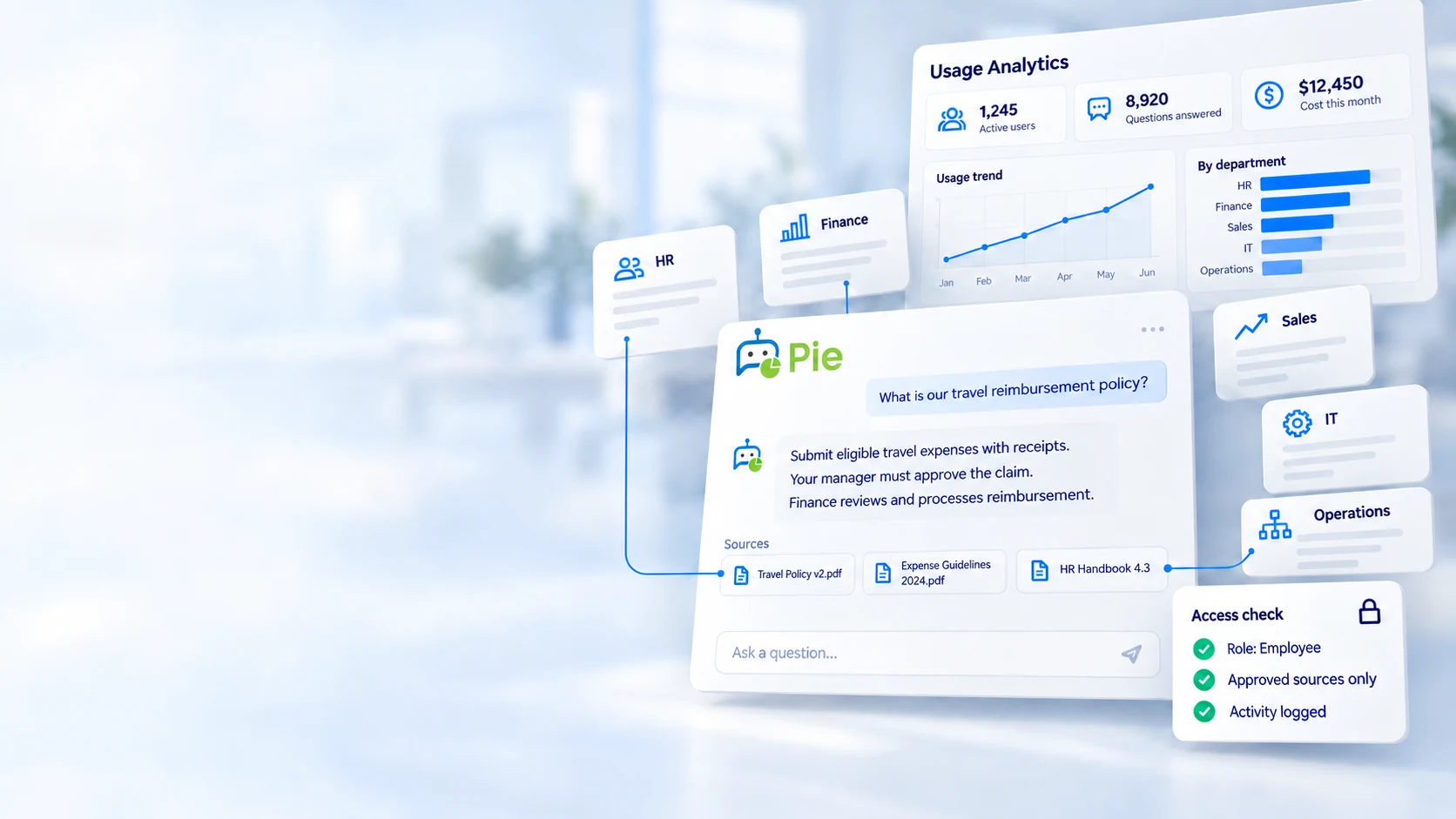
Pie (Precise. Intelligent. Experience.) is an enterprise-grade Agentic AI platform that enables organizations to build and deploy AI agents on their own enterprise data. Combining leading LLMs, RAG, and enterprise orchestration, Pie delivers secure, context-aware AI with RBAC, data protection, and governance built in—empowering businesses to automate workflows, access trusted knowledge, and make faster, smarter decisions at scale.
Modules
A Connected Core for Enterprise AI
GPT Store — Enterprise AI Application Hub

GPT Store — Enterprise AI Application Hub
Provide a centralized location for Enterprise GPT, domain-specific agents, internal AI applications, and approved third-party solutions. Give users a common entry point to the AI capabilities available within their organizational permissions.
AI Engine — Knowledge, Context & Execution

AI Engine — Knowledge, Context & Execution
Combine Retrieval-Augmented Generation (RAG), multimodal processing, and contextual reasoning to ground AI interactions in enterprise information. Support knowledge retrieval, document analysis, and agentic workflows that interact with business systems.
LLM Orchestration — Model Choice & Control

LLM Orchestration — Model Choice & Control
Route requests across commercial, open-source, cloud-hosted, and on-premises language models. Manage model configuration, fallback, and policy- and cost-aware selection through a centralized orchestration layer.
Capabilities
Enterprise Knowledge and Systems Connected to Intelligent Action

Agentic Workflow Automation
Coordinate specialized agents to retrieve information, analyze data, execute tasks, and interact with enterprise applications, supporting complex workflows across business functions.

Enterprise Knowledge Retrieval
Search and contextualize information across data lakes, databases, policy repositories, and documents, using RAG and semantic retrieval to provide source-referenced responses.

MCP & API-Based Integration
Enable agents to access approved tools and services through MCP and APIs, connecting AI workflows with CRM, ERP, HRMS, document repositories, and other business applications.

Multimodal, Context-Aware Interaction
Support text, voice, and document-based interactions with context retention for follow-up questions. Deliver accessible AI experiences across enterprise channels such as web, Teams, Slack, and WhatsApp.

Prompt Management
Centralize prompt authoring, versioning, and testing, with governed system instructions across GPTs and agents to support consistent application behavior.

Observability & Execution Monitoring
Monitor application and agent activity through centralized logs, metrics, alerts, feedback, and workflow traces, helping teams investigate failures and evaluate performance.

AI FinOps & Cost Governance
Track usage, adoption, and AI expenditure across applications and agents. Apply budgets and quotas, with showback or chargeback reporting for IT and finance stakeholders.
Architecture
AI governance & security
Enterprise Control Across Users, Data, Models, and AI Actions

Identity & Granular Access Control
Integrate Single Sign-On, including Microsoft Entra ID and other identity providers. Apply role-based permissions at the application, GPT, agent, department, folder, and file levels.

Data Protection & Approved Boundaries
Protect information with encryption in transit and at rest, centralized authentication, and authorization. Restrict AI access to approved organizational data and tools.

Human Oversight & Responsible AI
Retain human review for critical decisions, supported by source-referenced responses, bias-aware model selection and monitoring, and responsible data-use principles.

Auditability & Policy Governance
Maintain immutable execution logs and versioned prompts, models, and configurations to support internal audit and regulatory review. Apply policy guardrails aligned with organizational requirements related to GDPR, HIPAA, SOC 2, and other applicable standards.

Deployment & Data Residency Choice
Deploy on cloud, private infrastructure, or hybrid environments, allowing organizations to match AI adoption with security, infrastructure, and data-residency requirements.
Business impact
Enterprise AI Investment Connected to Business Value

Faster, Better-Informed Decisions
Give authorized employees timely access to relevant enterprise knowledge, reducing the effort required to find information and establish business context.
Lower Operational Effort
Reduce repetitive information retrieval, document analysis, and workflow tasks, allowing teams to focus on work that requires expertise and judgment.

More Consistent AI Adoption
Offer a shared enterprise experience for approved AI applications, making capabilities easier to access and reuse across departments.
Greater Control of AI Spend
Help IT and finance understand consumption, allocate budgets, and evaluate adoption, supporting more informed decisions about where to expand AI investment.

Technology Flexibility
Retain the freedom to select models and deployment environments as business needs evolve, reducing dependence on a single model provider.

Governed AI at Enterprise Scale
Expand AI adoption while preserving organizational permissions, oversight, and traceability, giving leadership greater confidence in how AI operates.