Enterprise AI Enablement & Governance Platform

Operationalize and Scale AI Across Your Enterprise
A unified foundation for developing, deploying, and governing enterprise AI.
Challenges
Scaling AI Requires a Consistent Enterprise Approach
As AI initiatives grow, organizations must coordinate development, assess production readiness, and establish accountability. Separate projects can demonstrate value individually while remaining difficult to manage across the enterprise.
Fragmented AI Development
Different teams may adopt separate tools and delivery practices. This makes it harder to share successful work, compare progress, and establish consistent expectations across departments.
Repeated Implementation Effort
Rebuilding similar foundations for each initiative consumes time and resources. Teams need a way to apply existing work while retaining flexibility for distinct business requirements.
Gaps Between Pilots and Production
A successful demonstration does not establish operational readiness. Before expanding adoption, organizations must determine how a solution will be evaluated, maintained, and integrated into everyday work.
Inconsistent Governance
AI initiatives need clear ownership and review practices. Without a common approach, leadership can struggle to assess whether teams are applying enterprise policies consistently.
Different Levels of Readiness
Business functions vary in their data maturity, priorities, and technical resources. Enterprise AI adoption needs to accommodate these differences without losing a common operating foundation.
Overview
Why aptAIHub?
A Unified Foundation for Enterprise AI Adoption
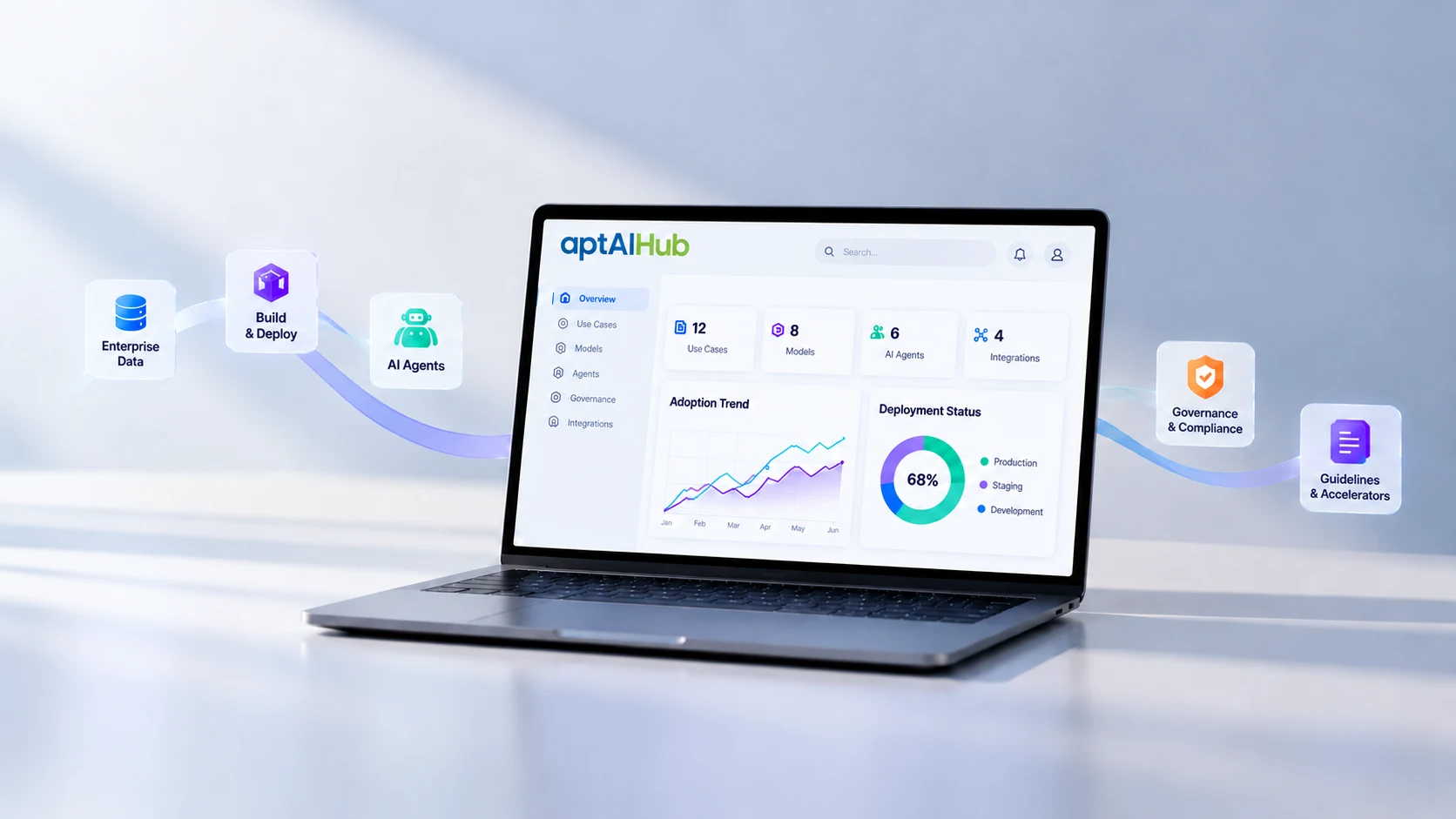
aptAIHub combines model engineering, governed data, agentic AI, and reusable accelerators within one modular ecosystem. It helps organizations develop and operationalize AI initiatives using a shared foundation tailored to their industry requirements and data maturity. With MLOps, LLMOps, enterprise integration, and built-in governance, aptAIHub supports the transition from pilots to production. Reusable blueprints reduce duplicated effort, while flexible infrastructure supports adoption across teams and business functions.
Modules
Seven Connected Components for Enterprise AI Delivery
AI Platform & Model Engineering Tools

AI Platform & Model Engineering Tools
Provide low-code and pro-code environments for model design, training, tuning, and monitoring. This gives teams different development options within the platform, according to their technical requirements.
Data & Feature Hub

Data & Feature Hub
Centralize governed datasets, feature stores, synthetic data tools, and lineage. Give development teams a clearer foundation for understanding the data available to an initiative and its origins.
AI Use Case Factory

AI Use Case Factory
Provide industry accelerators and solution blueprints for pilots and production. These offer a starting point for development, helping teams focus their effort on the requirements specific to the business.
Agentic AI Enablement

Agentic AI Enablement
Support AI agents, copilots, and multi-agent orchestration through dedicated tools and frameworks. Enable teams to design applications in which agents perform defined tasks and coordinate their work.
AI Governance

AI Governance
Include bias detection, explainability, responsible AI, and model auditability. Make these considerations part of development and review, so teams can examine how a solution behaves before expanding its use.
Guideline Repositories

Guideline Repositories
Maintain playbooks and operating guidelines aligned with enterprise policies and ethical standards. Give teams a shared reference for development decisions and expected operating practices.
Tools & Accelerators

Tools & Accelerators
Offer reusable components, integrations, adapters, and templates. Help teams apply established building blocks while adapting implementation to the needs of each initiative.
Capabilities
Shared Services Supporting the AI Lifecycle

Model Lifecycle Operations
Coordinate MLOps and LLMOps across AI initiatives. Provide an operating foundation for managing models beyond their initial development and keeping ongoing responsibilities visible.

Cross-Functional Development Services
Support data preparation, model training, and evaluation. Bring these activities into a connected delivery approach so teams can assess readiness at successive development stages.

Production Observability
Provide observability and telemetry for production AI. Give technical teams information they can use to investigate behavior and assess whether an application is operating as expected.

Enterprise Application Connectivity
Provide integration hooks and API-ready services for business applications. Help teams plan how AI functionality will connect with existing systems and fit into established processes.

Flexible Infrastructure
Support AI workloads across AWS, Azure, GCP, and hybrid environments. Allow infrastructure choices to reflect the organization’s operating requirements and existing technology investments.
Architecture
Business impact
A Stronger Foundation for Enterprise AI Investment

Faster Progress Toward Business Value
Give teams a more structured starting point for new initiatives. Reduce time spent establishing the delivery approach so more attention can go toward testing business relevance.

Less Duplicated Development Effort
Encourage reuse across initiatives instead of repeatedly building similar foundations. Help leadership direct development resources toward requirements that need new work.

More Consistent Governance
Establish shared expectations for AI development and operation. Give leadership a clearer basis for reviewing accountability and deciding whether an initiative is ready to expand.

More Manageable Enterprise Adoption
Provide a common foundation as additional teams adopt AI. Support growth without requiring every department to establish its own complete operating approach.

Better Alignment with Business Readiness
Match implementation to industry requirements and data maturity. Help organizations choose an appropriate starting point and expand adoption as their readiness develops.