Enterprise AI Engineering & MLOps Platform

Build Enterprise AI with Production Readiness in Mind
Connect experimentation, validation, and deployment through a structured engineering foundation.
Challenges
Successful Experiments Need a Clear Path to Production
Enterprise AI initiatives must progress beyond technical demonstrations. Teams need to establish whether a solution performs as intended, can be maintained, and fits its operating environment.
Repeated Development Effort
Starting each initiative independently can consume resources on foundations that earlier projects have already established.
Difficult Experiment Comparison
Without consistent evaluation practices, teams can struggle to explain why one approach should advance over another.
Gaps in Production Readiness
Development success alone does not resolve questions about deployment, monitoring, ownership, and ongoing maintenance.
Disconnected Delivery Responsibilities
Data scientists, engineers, architects, and business stakeholders need a shared basis for reviewing progress and making release decisions.
Overview
Why aptAIFoundry?
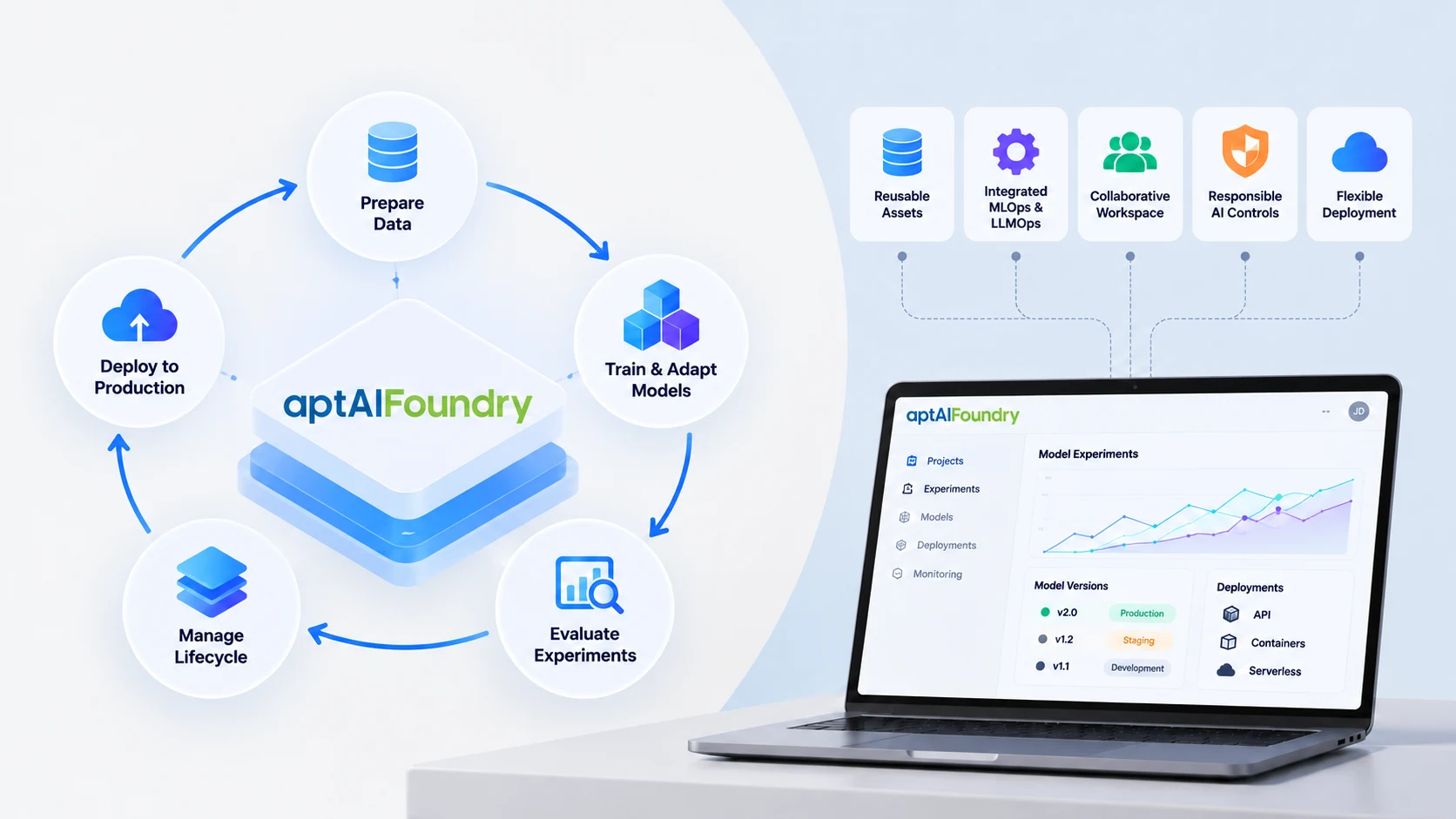
aptAIFoundry brings reusable AI assets, model experimentation, validation, and deployment workflows into a centralized engineering environment. It helps data and AI teams build custom solutions while keeping production readiness central to development. With integrated MLOps and LLMOps, collaborative workspaces, and responsible AI controls, teams can manage the transition from experimentation to production. Model tracking, evaluation, and monitoring support informed release decisions and ongoing improvement.
Modules
Capabilities
Shared Foundations for Reliable AI Engineering

Reusable Development Assets
Access models, prompts, embeddings, pipelines, and templates. Give teams an established starting point while retaining room for project-specific work.

Integrated MLOps & LLMOps
Connect versioning, evaluation, deployment automation, and monitoring. Keep ongoing operation connected to development decisions.

Collaborative Engineering Workspace
Provide notebooks, sandboxes, experiment tracking, role-based access, and Git/CI/CD integration. Support coordination between contributors working on the same initiative.

Responsible Development Controls
Include privacy-preserving AI, explainability, fairness testing, and audit logs. Bring these considerations into reviews of solution readiness.

Deployment Choice
Support cloud, on-premises, and edge environments. Assess the intended operating environment before committing to wider deployment.
Architecture
AI engineering workflow
Connected Activities Across Development and Operation

Data Preparation & Feature Engineering
Support data transformation, wrangling, and embeddings. Establish suitable inputs before evaluating model behavior.

Model Training & Adaptation
Enable supervised, unsupervised, and reinforcement learning, alongside fine-tuning and RAG customization. Select development approaches according to the task.

Experimentation & Evaluation
Test prompts, hyperparameters, and inference performance. Use evaluation to inform decisions about which approaches should advance.

Model Lifecycle Management
Track versions, artifacts, and performance. Preserve the information teams need to understand changes during development and operation.
Deployment Pipelines
Use containers, APIs, and serverless functions for production handoff. Make deployment requirements part of the engineering process.
Business impact
A Stronger Basis for AI Delivery Decisions

More Focused Development Effort
Reduce time spent recreating foundations so teams can concentrate on requirements that need new engineering.

Better-Informed Release Decisions
Use development evidence to assess readiness, helping stakeholders make clearer decisions about whether a solution should progress.

Greater Delivery Continuity
Keep experimentation and operational requirements connected, reducing gaps between development responsibilities and production expectations.

Clearer Accountability
Give technical and business contributors a common basis for discussing changes, performance, and outstanding concerns.

More Disciplined Improvement
Treat release as a stage in the lifecycle. Evaluate subsequent changes against the solution’s purpose and operating requirements.