Enterprise Agentic AI Platform

Build Enterprise AI Agents. Govern Them. Scale Them.
Connect intelligent agents to enterprise applications, data, and workflows with control built in.
Challenges
Scaling Enterprise Agents Requires Consistent Control
As organizations introduce agents into business workflows, they need clear boundaries for system access, task execution, and accountability. Independent implementations can increase engineering effort and make oversight harder as adoption grows.
Repeated Development Effort
Building agents, tools, and integrations separately for each requirement creates duplication and slows the delivery of new initiatives.
Disconnected Business Workflows
Agents need access to relevant enterprise applications and data to complete meaningful tasks. Isolated implementations can limit their operational value.
Inconsistent Execution Controls
Without common permissions, policies, and approval requirements, teams may apply different standards to agent actions.
Limited Accountability
Business owners need to understand what an agent did, which tools it used, and who approved consequential actions.
Unpredictable Consumption
Growing agent usage requires defined budgets and limits so teams can manage consumption before costs accumulate.
Overview
Why aptAIAgentFactory?
aptAIAgentFactory brings agent development, enterprise integration, and controlled execution into one platform. It helps teams build specialized agents that work across business applications, data, and workflows using approved tools and connectors. With reusable capabilities, human approvals, execution traceability, and budget controls, organizations can expand agent adoption while maintaining accountability. Model and deployment flexibility support evolving technology requirements without repeatedly rebuilding agent capabilities.
Modules
Connected Functions for Building and Operating Enterprise Agents
Enterprise Agent Development

Enterprise Agent Development
Build specialized agents for knowledge retrieval, analytics, document processing, business operations, and multi-step tasks. Define agent capabilities around the enterprise work they need to support.
Enterprise System Integration

Enterprise System Integration
Connect agents to ERP, CRM, productivity, and collaboration systems through governed enterprise connectors. Integrations include SAP, NetSuite, Salesforce, HubSpot, Workday, and Google Workspace.
Governed Agent Execution

Governed Agent Execution
Apply permissions, policies, safety controls, budget limits, and approval requirements before agents execute actions. Establish consistent execution boundaries across enterprise workflows.
Human-in-the-Loop Workflows

Human-in-the-Loop Workflows
Pause sensitive actions for review, approval, or additional input, then resume execution from the same point. Keep human decision-making within workflows that require oversight.
Reusable Agent Marketplace

Reusable Agent Marketplace
Maintain a governed catalog of approved agents, tools, and integrations. Help teams discover and reuse existing capabilities across business functions.
Model & Provider Flexibility

Model & Provider Flexibility
Use commercial, cloud, and self-hosted AI models without rebuilding the underlying agent logic. Support model choice while preserving established agent capabilities.
Capabilities
A Common Foundation for Agent Delivery and Operation

Reusable Agent & Tool Components
Develop capabilities once and apply them across multiple workflows. Use shared agents, tools, and integration patterns to support future enterprise requirements.

Agent Orchestration & Routing
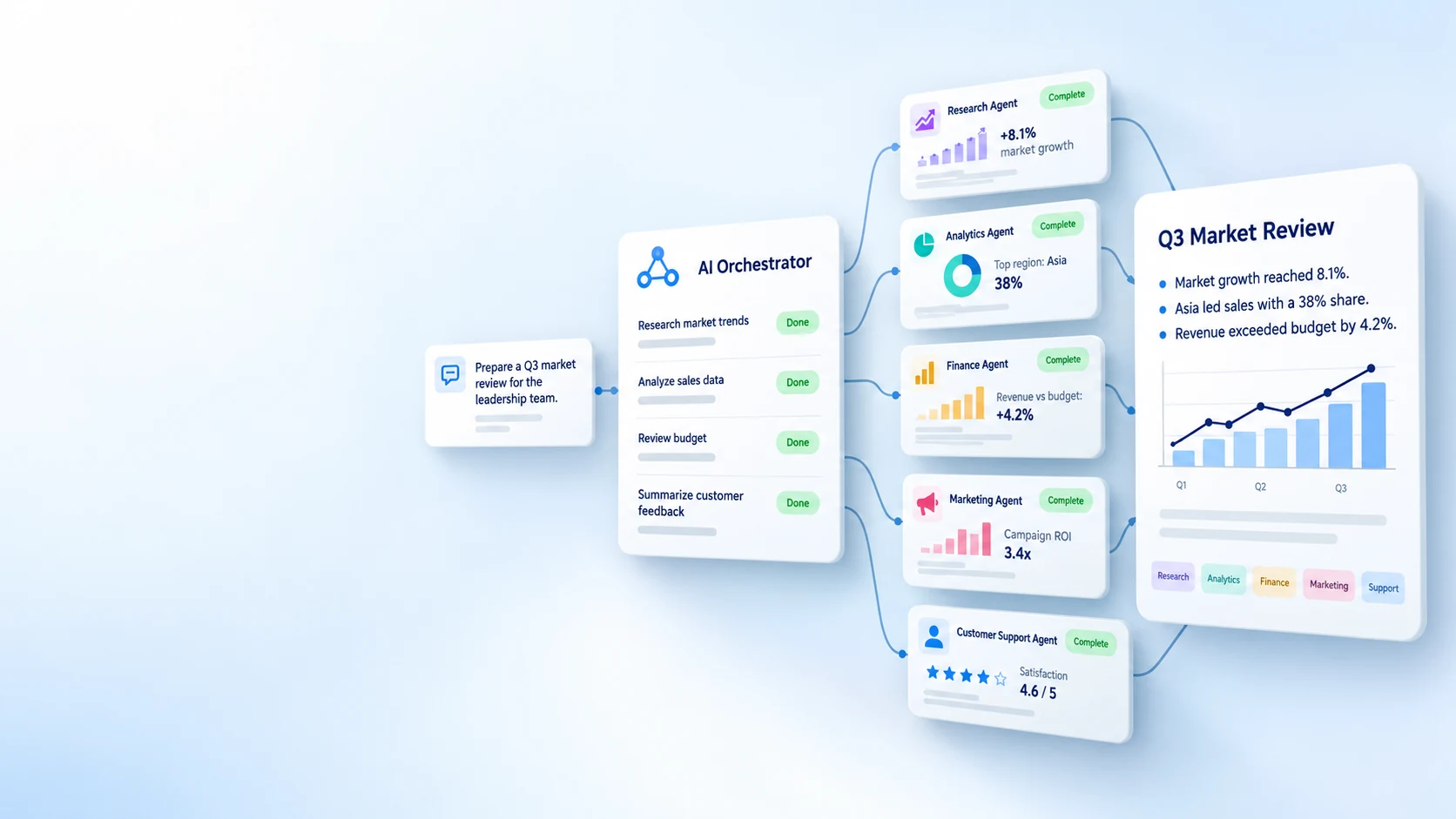
Coordinate reasoning, tool execution, and agent routing through a common foundation. Connect individual capabilities into workflows that support multi-step enterprise tasks.

Policy & Usage Enforcement
Enforce execution policies and consumption limits before actions proceed. Apply consistent guardrails as agents move between teams and environments.

Execution Traceability
Record agent runs, tool calls, model interactions, and approval decisions. Make activity attributable to a user, request, and point in time.

Deployment Flexibility
Support managed, dedicated, and customer-controlled environments. Maintain consistent agent capabilities and governance across supported deployment approaches.
Architecture
Agent standards
Consistent Enterprise Requirements for Every Agent
Apply a common set of standards before releasing agents to business users, and review them as their capabilities and operating environments change.

Defined Scope & Ownership
Document each agent’s purpose, assign a business owner, and establish explicit boundaries for permitted activities.

Least-Privilege Access
Give agents only the systems, data, and permissions required for their tasks, avoiding blanket enterprise access.
Approved Tools & Connectors
Restrict execution to governed, pre-approved tools and connectors so available actions remain known and reviewable.

Human Approval & Change Review
Require human review for consequential actions involving customers, money, important records, or production systems. Propose changes to enterprise content, records, and workflows for approval before applying them.

Budget & Usage Guardrails
Define consumption, cost, and rate limits for each agent. Enforce these boundaries before execution.

Validation Before Wider Release
Evaluate new agents and capabilities through controlled enablement. Expand availability after the required review and sign-off.

Consistent Documentation
Catalog agents, tools, and integrations to a common standard so teams can understand their purpose and reuse them confidently.
Business impact
Enterprise Agents That Support Scalable Business Operations

Faster AI Adoption
Accelerate new initiatives by building on approved agents, tools, and connectors, reducing the work required to establish each implementation.
Lower Repeated Engineering Effort
Turn capabilities developed for individual requirements into reusable assets, allowing teams to focus on work that requires new development.

AI Embedded into Business Workflows
Enable agents to support operational tasks within enterprise applications, connecting intelligence with the systems where work takes place.

Greater Control as Adoption Expands
Maintain consistent oversight across teams through defined ownership, execution boundaries, and approval practices.

Better Visibility into Usage & Cost
Give stakeholders a clearer view of agent activity and consumption, supported by controls that help manage expenditure.

Greater Technology Flexibility
Reduce dependency on individual AI providers by separating agent capabilities from underlying models and infrastructure wherever supported.