For years, enterprise AI was built around a simple interaction model: a human asks, and the AI responds. That model powered copilots, chat assistants, and productivity tools that improved efficiency in isolated tasks. But enterprises are now entering a new phase of AI adoption — one where AI systems are no longer acting alone. Multi-agent AI systems are emerging as the next evolution of enterprise automation. Instead of relying on a single large language model to manage an entire workflow, organizations are deploying networks of specialized AI agents that collaborate, coordinate, and execute tasks together.
This shift is redefining how businesses think about automation, decision-making, and operational scalability.
From Single AI Assistants to Coordinated AI Systems
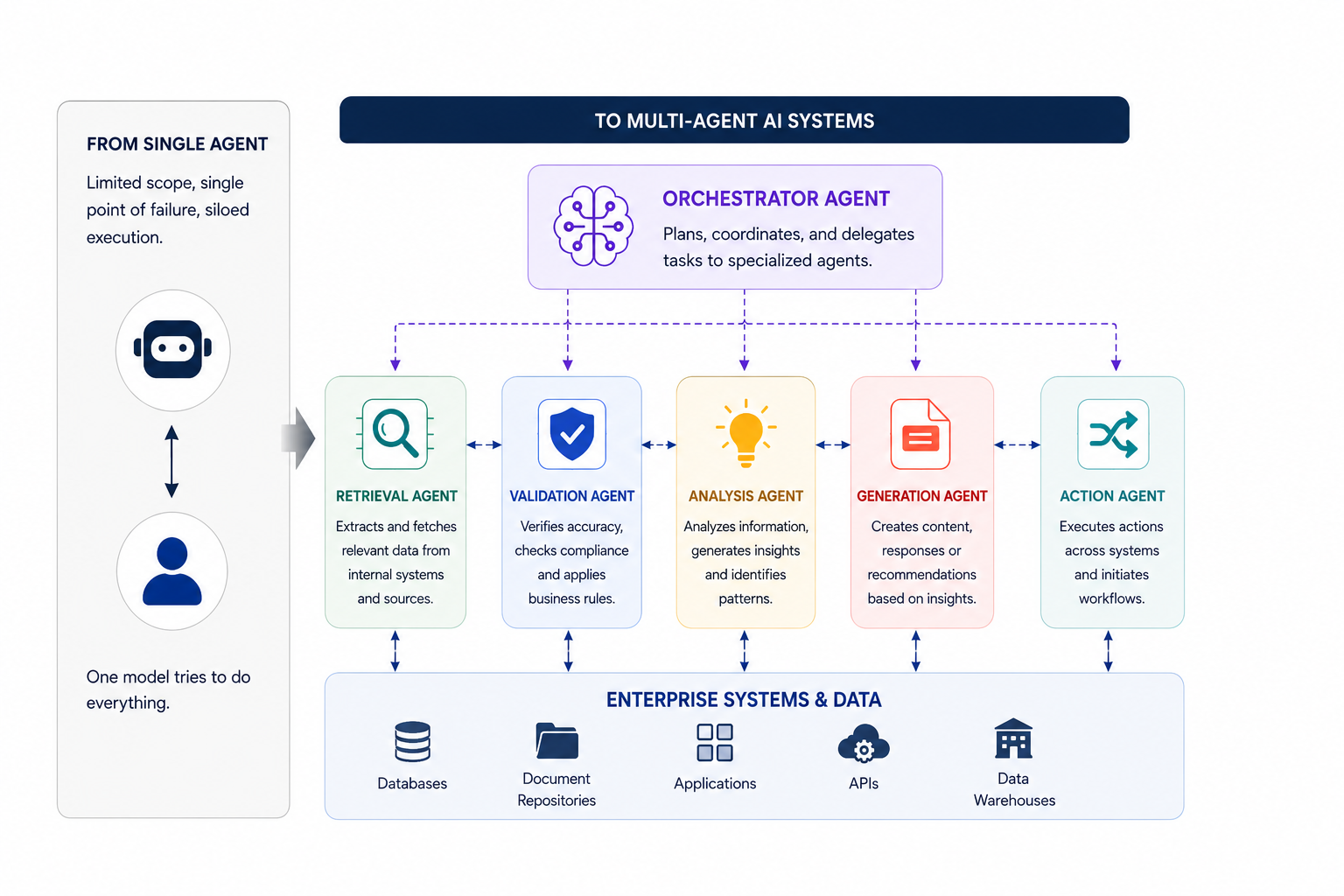
Early enterprise AI applications focused heavily on augmentation. AI copilots helped employees summarize documents, generate content, or answer questions faster. While valuable, these systems largely operated within narrow boundaries. Multi-agent systems change that architecture entirely. In a multi-agent environment, different AI agents are assigned specialized responsibilities. One agent may retrieve enterprise data, another may validate compliance requirements, another may generate insights, while a coordinating agent orchestrates the workflow and ensures task completion. Instead of one model attempting to do everything, enterprises distribute intelligence across multiple agents designed for distinct functions.
This mirrors how modern organizations themselves operate — through teams of specialists collaborating toward shared goals.
Why Enterprises Are Moving Toward Multi-Agent Architectures
The rise of multi-agent systems is not simply a technological trend. It is largely driven by the operational limitations enterprises encountered with single-agent AI deployments.
As workflows become more complex, enterprises require systems that can:
- Handle multi-step reasoning
- Access multiple enterprise systems
- Coordinate across departments
- Operate with human oversight
- Adapt dynamically to changing conditions
- Scale without central bottlenecks
Single-agent architectures struggle to maintain reliability and context across these environments. Multi-agent systems address this by breaking workflows into modular, manageable units. This modularity creates several enterprise advantages:
Improved Scalability
Specialized agents can scale independently depending on workload demand. Enterprises can optimize resources more effectively without overloading a single orchestration layer.
Better Reliability
Failures become isolated rather than systemic. If one agent encounters an issue, other agents can continue functioning while escalation or fallback mechanisms activate.
Domain Specialization
Agents can be trained or optimized for specific business functions such as fraud detection, supply chain analysis, compliance monitoring, or customer support.
Faster Workflow Execution
Parallel processing enables multiple agents to work simultaneously across tasks, significantly reducing operational latency.
The Enterprise Use Cases Driving Adoption
Multi-agent systems are already gaining traction across several enterprise functions.
Intelligent Customer Operations
Customer service workflows increasingly involve multiple specialized agents working together:
- Intent classification agents
- Knowledge retrieval agents
- Sentiment analysis agents
- Resolution recommendation agents
- Escalation agents
Instead of a single chatbot attempting end-to-end support, enterprises are building coordinated ecosystems capable of delivering faster and more contextual customer experiences.
Financial Services and Risk Operations
Banks and insurance organizations are exploring multi-agent systems for areas such as:
- Fraud detection
- Claims processing
- Policy validation
- Compliance checks
- Risk assessment
Research suggests that agent-based automation is particularly effective in environments requiring multi-step validation and auditability.
Software Development and IT Operations
AI agents are increasingly participating in software engineering workflows, including:
- Code generation
- QA testing
- Vulnerability scanning
- Deployment validation
- Infrastructure monitoring
At Dell Technologies World 2026, enterprise leaders highlighted how agentic AI systems are already reducing development timelines and accelerating DevOps workflows.
Enterprise Knowledge and Decision Systems
Organizations are deploying multi-agent architectures to improve enterprise search, internal research, and decision intelligence.
In these systems:
- Retrieval agents gather information
- Validation agents verify credibility
- Summarization agents synthesize insights
- Governance agents enforce policy controls
This layered orchestration significantly improves reliability compared to traditional retrieval-only systems.
Why Governance and Orchestration Matter More Than Ever
As enterprises scale agentic AI, orchestration becomes the defining challenge. The problem is no longer whether AI can generate outputs. The challenge is whether enterprises can coordinate multiple AI systems safely, consistently, and transparently across real workflows.
This introduces new operational requirements:
Agent Orchestration Frameworks
Enterprises now require orchestration layers capable of:
- Task delegation
- State management
- Inter-agent communication
- Workflow prioritization
- Human approval routing
Frameworks such as LangGraph, AutoGen, and CrewAI are increasingly being explored for enterprise-scale orchestration.
Governance and Observability
As agents gain autonomy, governance becomes critical.
Organizations must establish:
- Real-time monitoring
- Audit trails
- Policy enforcement
- Security guardrails
- Human-in-the-loop validation
According to industry research, governance failures remain one of the biggest reasons AI agent pilots fail to scale into production.
Enterprises are realizing that trust cannot be added later. It must be embedded directly into agent architectures.
This includes:
- Explainability layers
- Permission controls
- Reliability scoring
- Failure recovery systems
- Compliance enforcement
Without these controls, autonomous workflows quickly become operational risks rather than productivity multipliers.
The Shift From AI Tools to AI Workforces
Perhaps the most important shift is conceptual. Enterprises are beginning to move beyond thinking of AI as a standalone tool. Instead, AI is increasingly being treated as a coordinated digital workforce capable of participating in business operations. This does not mean fully autonomous organizations are imminent. Human oversight remains essential, particularly in regulated or high-risk environments. In fact, many enterprises continue validating AI decisions through human review layers before execution.
But the role of AI is clearly expanding:
- From assistance to execution
- From isolated prompts to orchestrated workflows
- From single systems to collaborative agent ecosystems
That transition may ultimately define the next generation of enterprise software.
The Road Ahead
Multi-agent AI systems represent a major architectural shift in enterprise AI adoption. The organizations seeing the greatest value are not simply deploying smarter models. They are redesigning workflows around coordinated intelligence, orchestration, and operational integration.
The future of enterprise AI will likely depend less on individual model capability and more on how effectively enterprises can:
- Coordinate specialized agents
- Govern autonomous workflows
- Integrate AI into core business operations
- Maintain trust, accountability, and transparency at scale
The rise of multi-agent systems signals that enterprises are moving beyond experimentation and toward operational AI infrastructure. And in that future, the most successful enterprises may not be the ones with the largest models — but the ones with the best orchestration.