Blog Detail

Embedding AI into Business Workflows—Not Just Dashboards

Written by
Smriti Lal
Generative AI
Published on
March 23, 2026
Share
Table of Contents

Why insight alone is no longer enough

Enterprises today are not short on data, models, or dashboards.Over the last decade, significant investments have gone into building data platforms, deploying machine learning models, and democratizing access to insights. Across functions, dashboards now surface predictions, trends, and recommendations in near real time.And yet, for many organizations, the business impact remains incremental.

The challenge is not the absence of intelligence—it is the distance between intelligence and action.Most AI systems are still designed to inform decisions, not to participate in them.

The hidden gap between knowing and doing

In a typical enterprise setup, AI operates as an analytical layer. Data is processed, models generate outputs, and insights are presented to business users through dashboards. From there, action depends on human interpretation, prioritization, and execution.This creates an inherent lag.By the time an insight is reviewed, validated, and acted upon, the underlying context may have already shifted. Customer behavior evolves, market conditions change, and operational realities move forward.

What remains is a system where intelligence is available—but not timely enough to influence outcomes at the moment they matter most.

Reimagining AI as part of the operating fabric

To unlock meaningful value, organizations need to rethink the role of AI.Instead of treating it as a reporting or advisory layer, AI must become embedded within the workflows where decisions are made and executed. This shift transforms AI from a passive observer into an active participant in business processes.In this model, decisions are no longer triggered by someone reading a dashboard. They are initiated within the system itself—guided by data, refined by models, and executed in real time within defined business constraints.

The question changes from “What is happening?” to “What should we do next?”

From periodic insights to continuous decisioning

Embedding AI into workflows fundamentally alters how decisions are made.In customer engagement, for instance, identifying churn risk is only the starting point. The real value lies in triggering the right intervention—through the right channel—at the right moment. Similarly, in pricing, reviewing performance metrics periodically is far less effective than continuously adjusting prices based on demand signals, customer sensitivity, and competitive dynamics.Across these scenarios, the shift is not about better visibility. It is about enabling systems to respond as conditions evolve.

AI moves from generating insights at intervals to driving decisions continuously.

What it takes to embed AI into workflows

This transition is not simply a matter of deploying more models. It requires a different way of designing systems—one that starts with decisions rather than data.At the core is a decision-centric approach, where key business decisions are identified, structured, and supported by AI. Each decision is defined by its context, objective, and constraints, allowing models to operate within clear boundaries while still adapting dynamically.Equally important is the ability to work with data in motion. Real-time or near real-time data pipelines ensure that decisions are based on the latest signals rather than historical snapshots. Without this, even the most sophisticated models risk becoming outdated in fast-changing environments.

Another critical element is feedback. When AI is embedded into workflows, every action taken generates new data. Capturing and learning from these outcomes allows systems to continuously refine their decisions, creating a closed loop where performance improves over time.Finally, integration plays a defining role. AI cannot remain isolated from operational systems. It must be connected to platforms such as CRM, marketing automation, supply chain systems, and pricing engines—so that decisions are not just recommended, but executed seamlessly.

From predictive models to decision systems

Traditional AI has largely focused on prediction—forecasting what is likely to happen. While valuable, prediction alone does not drive outcomes.What organizations increasingly need is prescriptive capability: systems that determine the best course of action and enable its execution.This is where embedded AI differentiates itself. It bridges the gap between prediction and action, ensuring that insights translate into measurable business results.In doing so, AI evolves from being a tool used by analysts to becoming a system that actively shapes business performance.

Where the impact becomes visible

When AI is embedded into workflows, its impact is no longer confined to reports or dashboards—it becomes visible in outcomes.Revenue growth improves as pricing, promotions, and personalization adapt dynamically. Operational efficiency increases as decisions are automated and optimized. Customer experience becomes more responsive and context-aware.Perhaps most importantly, organizations gain agility. They are able to respond to change not in cycles, but in real time.

The road ahead

The next phase of AI adoption will not be defined by more sophisticated models or larger datasets. It will be defined by how effectively intelligence is integrated into the way businesses operate.Organizations that continue to treat AI as an analytical layer will see incremental gains. Those that embed AI into workflows will unlock step-change impact.

Because in the end, dashboards can inform decisions.

But only workflows can deliver them.

Turning intelligence into action—where it matters most.

Similar Blogs

Stay Ahead in AI & Data Innovation

Stay informed with expert insights on AI, data governance, and emerging technologies. Explore thought leadership, industry trends, and the future of AI-driven innovation.
Blog

From Monitoring to Autonomous Oversight: The Future of Banking Compliance

For decades, banking compliance has operated on a reactive model. Financial institutions monitored transactions, reviewed reports, investigated anomalies, and responded to regulatory requirements after the fact. Compliance teams relied heavily on manual workflows, periodic audits, rule-based systems, and fragmented monitoring processes to manage growing regulatory complexity.But the compliance landscape is changing rapidly.

As regulatory expectations intensify and financial ecosystems become increasingly digital, traditional monitoring approaches are struggling to keep pace. Banks are now exploring a new operational paradigm—one where AI systems move beyond passive monitoring and toward autonomous oversight. This shift is redefining how financial institutions approach compliance, risk management, fraud detection, and operational resilience.

Why Traditional Compliance Models Are Reaching Their Limits

Modern banks process millions of transactions, customer interactions, and operational events every day. At the same time, regulatory frameworks continue to evolve across critical areas such as anti-money laundering (AML), Know Your Customer (KYC), fraud detection, transaction monitoring, data privacy, risk reporting, and operational governance. Managing these interconnected requirements has become increasingly challenging.

Traditional compliance infrastructures were never designed for this level of scale and complexity. Many institutions still rely on siloed compliance systems, static rule engines, manual investigations, batch-based reviews, and retrospective auditing practices. While these approaches have served organizations for years, they often struggle to provide the speed, flexibility, and visibility needed in today's digital banking environment.

As transaction volumes continue to grow, these legacy models contribute to high false-positive rates, delayed risk detection, rising operational costs, compliance fatigue, limited scalability, and a lack of real-time visibility into emerging risks. The gap between compliance demands and operational capacity is widening, forcing organizations to rethink how oversight is performed.

The Shift Toward Autonomous Oversight

Autonomous oversight represents the next evolution of compliance operations.

Instead of relying solely on human teams to monitor and interpret risk signals, banks are increasingly deploying AI-driven systems capable of continuously monitoring transactions, detecting anomalies, validating compliance controls, investigating suspicious activity, generating regulatory reports, escalating high-risk events, and coordinating remediation workflows.

These systems do far more than automate individual tasks. They orchestrate end-to-end compliance processes with greater speed, consistency, and contextual intelligence. At the center of this transformation is Agentic AI.

What Makes Agentic AI Different?

Traditional AI systems are typically designed to respond to prompts or execute predefined workflows. Agentic AI introduces a fundamentally different approach by enabling systems to reason, plan, coordinate, and take actions autonomously within established governance boundaries.

In banking compliance environments, multiple specialized AI agents can work together across the compliance ecosystem:

  • Monitoring agents track transactions and activities in real time.
  • Risk agents identify unusual behavioral patterns and emerging threats.
  • Investigation agents gather contextual evidence and analyze anomalies.
  • Reporting agents generate audit-ready documentation and regulatory summaries.
  • Governance agents validate policy adherence and control effectiveness.
  • Escalation agents route high-risk cases for human review.

Rather than depending on a single monolithic AI model, banks can deploy specialized agents that collaborate intelligently. This creates a more adaptive, scalable, and resilient compliance architecture capable of responding to constantly changing regulatory and operational conditions.

From Reactive Compliance to Continuous Compliance

One of the most significant advantages of autonomous oversight is the transition from periodic monitoring to continuous compliance.

Traditionally, compliance reviews occur on a daily, weekly, monthly, or quarterly basis. However, risks emerge in real time. By the time a periodic review identifies an issue, the impact may already be significant.

AI-driven oversight systems continuously evaluate operational activity as it occurs, enabling earlier detection of suspicious behavior, faster response times, reduced compliance gaps, stronger regulatory readiness, and greater operational resilience. Instead of waiting for scheduled reviews, organizations gain a real-time understanding of risk exposure across their operations.

Continuous compliance also enhances transparency by generating ongoing audit trails and monitoring histories throughout business processes. For regulators, this level of visibility is becoming increasingly valuable as expectations around accountability and risk management continue to rise.

Reducing False Positives and Investigation Burden

False positives remain one of the most persistent challenges in banking compliance. Traditional rule-based monitoring systems often generate large volumes of alerts that require manual review, consuming significant time and resources.

As a result, compliance professionals frequently spend considerable effort investigating cases that ultimately present little or no actual risk.

Agentic AI can dramatically improve this process by correlating information across multiple data sources, understanding behavioral context, learning from historical investigations, prioritizing genuinely high-risk events, and automating the closure of low-risk cases.

This intelligent prioritization enables compliance analysts to focus their expertise on the investigations that matter most. The result is a more efficient compliance function that delivers stronger risk outcomes while reducing operational burden.

Strengthening Regulatory Reporting

Regulatory reporting continues to be one of the most resource-intensive functions within financial services. Institutions must gather information from multiple systems, validate data accuracy, maintain documentation, and meet increasingly stringent reporting timelines.

AI-driven oversight systems help streamline these processes by continuously validating data quality, tracking regulatory changes, generating dynamic compliance summaries, maintaining audit-ready evidence, and automating report preparation workflows.

Rather than treating reporting as a periodic activity, banks can move toward an always-on state of reporting readiness. This approach improves consistency, reduces manual effort, and enables organizations to respond more effectively to regulatory inquiries.

Why Governance Still Matters

Despite the rise of autonomous systems, human oversight remains essential.

Compliance decisions often require regulatory interpretation, ethical judgment, escalation management, customer impact assessment, and legal review. These responsibilities cannot be fully delegated to automated systems.

The objective is not to remove humans from compliance operations but to augment human expertise with intelligent systems capable of managing scale and complexity more effectively.

This makes governance a critical component of AI-driven compliance. Banks must establish robust frameworks that include human-in-the-loop controls, explainability mechanisms, auditability standards, access governance policies, model monitoring practices, bias detection processes, and clearly defined escalation protocols.

Without these safeguards, autonomous systems can introduce new operational and regulatory risks. Trust, transparency, and accountability remain foundational to successful adoption.

The Future of Banking Compliance

The future of banking compliance will be defined less by isolated automation and more by intelligent orchestration.

Banks are steadily moving toward ecosystems where AI agents continuously monitor operational environments, identify risks proactively, adapt to changing regulations, and maintain real-time compliance readiness. Human teams, meanwhile, will spend less time on repetitive reviews and more time focusing on strategic oversight and decision-making.

This shift represents a fundamental transformation:

  • From static controls to adaptive intelligence.
  • From reactive investigations to predictive oversight.
  • From fragmented systems to coordinated compliance ecosystems.

In many ways, compliance is evolving from a cost center into a strategic resilience capability that supports trust, growth, and long-term operational stability.

Final Thoughts

As regulatory complexity continues to increase, banks can no longer rely solely on manual monitoring models built for slower and simpler environments.

Autonomous oversight powered by Agentic AI offers a path toward:

  • Scalable compliance operations
  • Faster risk detection
  • Improved reporting accuracy
  • Reduced operational burden
  • Greater regulatory confidence

However, technology alone is not enough. The institutions that succeed will be those that combine intelligent automation with strong governance, transparency, and human accountability.Because the future of banking compliance is not fully autonomous.

It is intelligently supervised, continuously adaptive, and built on trusted oversight at scale.

Blog

The Rise of Multi-Agent AI Systems in Enterprises

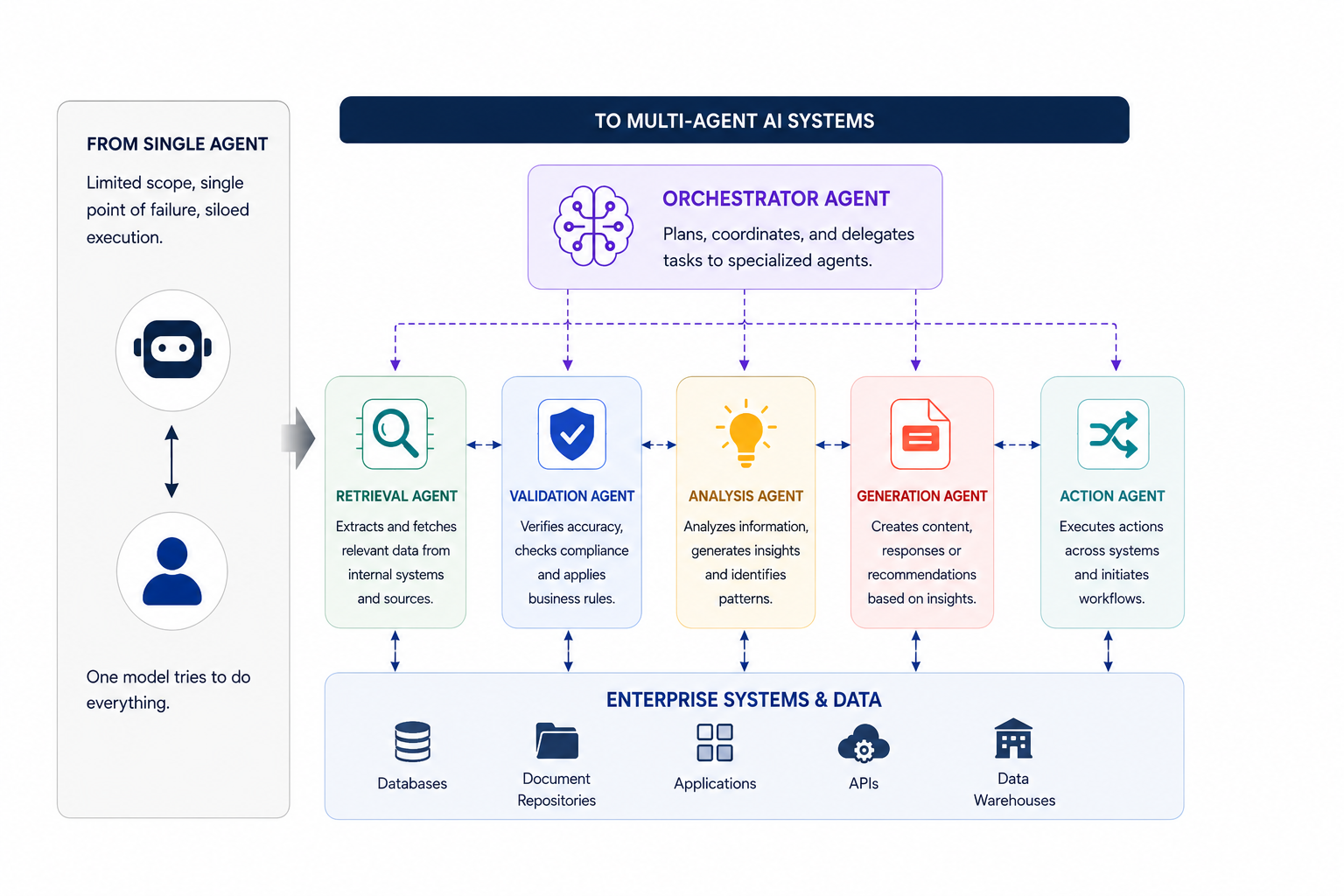
For years, enterprise AI was built around a simple interaction model: a human asks, and the AI responds. That model powered copilots, chat assistants, and productivity tools that improved efficiency in isolated tasks. But enterprises are now entering a new phase of AI adoption — one where AI systems are no longer acting alone.Multi-agent AI systems are emerging as the next evolution of enterprise automation. Instead of relying on a single large language model to manage an entire workflow, organizations are deploying networks of specialized AI agents that collaborate, coordinate, and execute tasks together.

This shift is redefining how businesses think about automation, decision-making, and operational scalability.

From Single AI Assistants to Coordinated AI Systems

Early enterprise AI applications focused heavily on augmentation. AI copilots helped employees summarize documents, generate content, or answer questions faster. While valuable, these systems largely operated within narrow boundaries.Multi-agent systems change that architecture entirely.In a multi-agent environment, different AI agents are assigned specialized responsibilities. One agent may retrieve enterprise data, another may validate compliance requirements, another may generate insights, while a coordinating agent orchestrates the workflow and ensures task completion.Instead of one model attempting to do everything, enterprises distribute intelligence across multiple agents designed for distinct functions.

This mirrors how modern organizations themselves operate — through teams of specialists collaborating toward shared goals.

Why Enterprises Are Moving Toward Multi-Agent Architectures

The rise of multi-agent systems is not simply a technological trend. It is largely driven by the operational limitations enterprises encountered with single-agent AI deployments.

As workflows become more complex, enterprises require systems that can:

  • Handle multi-step reasoning
  • Access multiple enterprise systems
  • Coordinate across departments
  • Operate with human oversight
  • Adapt dynamically to changing conditions
  • Scale without central bottlenecks

Single-agent architectures struggle to maintain reliability and context across these environments. Multi-agent systems address this by breaking workflows into modular, manageable units. This modularity creates several enterprise advantages:

Improved Scalability

Specialized agents can scale independently depending on workload demand. Enterprises can optimize resources more effectively without overloading a single orchestration layer.

Better Reliability

Failures become isolated rather than systemic. If one agent encounters an issue, other agents can continue functioning while escalation or fallback mechanisms activate.

Domain Specialization

Agents can be trained or optimized for specific business functions such as fraud detection, supply chain analysis, compliance monitoring, or customer support.

Faster Workflow Execution

Parallel processing enables multiple agents to work simultaneously across tasks, significantly reducing operational latency.

The Enterprise Use Cases Driving Adoption

Multi-agent systems are already gaining traction across several enterprise functions.

Intelligent Customer Operations

Customer service workflows increasingly involve multiple specialized agents working together:

  • Intent classification agents
  • Knowledge retrieval agents
  • Sentiment analysis agents
  • Resolution recommendation agents
  • Escalation agents

Instead of a single chatbot attempting end-to-end support, enterprises are building coordinated ecosystems capable of delivering faster and more contextual customer experiences.

Financial Services and Risk Operations

Banks and insurance organizations are exploring multi-agent systems for areas such as:

  • Fraud detection
  • Claims processing
  • Policy validation
  • Compliance checks
  • Risk assessment

Research suggests that agent-based automation is particularly effective in environments requiring multi-step validation and auditability.

Software Development and IT Operations

AI agents are increasingly participating in software engineering workflows, including:

  • Code generation
  • QA testing
  • Vulnerability scanning
  • Deployment validation
  • Infrastructure monitoring

At Dell Technologies World 2026, enterprise leaders highlighted how agentic AI systems are already reducing development timelines and accelerating DevOps workflows.

Enterprise Knowledge and Decision Systems

Organizations are deploying multi-agent architectures to improve enterprise search, internal research, and decision intelligence.

In these systems:

  • Retrieval agents gather information
  • Validation agents verify credibility
  • Summarization agents synthesize insights
  • Governance agents enforce policy controls

This layered orchestration significantly improves reliability compared to traditional retrieval-only systems.

Why Governance and Orchestration Matter More Than Ever

As enterprises scale agentic AI, orchestration becomes the defining challenge.The problem is no longer whether AI can generate outputs. The challenge is whether enterprises can coordinate multiple AI systems safely, consistently, and transparently across real workflows.

This introduces new operational requirements:

Agent Orchestration Frameworks

Enterprises now require orchestration layers capable of:

  • Task delegation
  • State management
  • Inter-agent communication
  • Workflow prioritization
  • Human approval routing

Frameworks such as LangGraph, AutoGen, and CrewAI are increasingly being explored for enterprise-scale orchestration.

Governance and Observability

As agents gain autonomy, governance becomes critical.

Organizations must establish:

  • Real-time monitoring
  • Audit trails
  • Policy enforcement
  • Security guardrails
  • Human-in-the-loop validation

According to industry research, governance failures remain one of the biggest reasons AI agent pilots fail to scale into production.

Enterprises are realizing that trust cannot be added later. It must be embedded directly into agent architectures.

This includes:

  • Explainability layers
  • Permission controls
  • Reliability scoring
  • Failure recovery systems
  • Compliance enforcement

Without these controls, autonomous workflows quickly become operational risks rather than productivity multipliers.

The Shift From AI Tools to AI Workforces

Perhaps the most important shift is conceptual.Enterprises are beginning to move beyond thinking of AI as a standalone tool. Instead, AI is increasingly being treated as a coordinated digital workforce capable of participating in business operations.This does not mean fully autonomous organizations are imminent. Human oversight remains essential, particularly in regulated or high-risk environments. In fact, many enterprises continue validating AI decisions through human review layers before execution.

But the role of AI is clearly expanding:

  • From assistance to execution
  • From isolated prompts to orchestrated workflows
  • From single systems to collaborative agent ecosystems

That transition may ultimately define the next generation of enterprise software.

The Road Ahead

Multi-agent AI systems represent a major architectural shift in enterprise AI adoption.The organizations seeing the greatest value are not simply deploying smarter models. They are redesigning workflows around coordinated intelligence, orchestration, and operational integration.

The future of enterprise AI will likely depend less on individual model capability and more on how effectively enterprises can:

  • Coordinate specialized agents
  • Govern autonomous workflows
  • Integrate AI into core business operations
  • Maintain trust, accountability, and transparency at scale

The rise of multi-agent systems signals that enterprises are moving beyond experimentation and toward operational AI infrastructure.And in that future, the most successful enterprises may not be the ones with the largest models — but the ones with the best orchestration.

Blog

From Sampling to Surveillance: How AI is Redefining Continuous Auditing in Banking

Introduction

Auditing in banking was never built for speed.It was built for assurance.For decades, audit frameworks relied on sampling, periodic reviews, and retrospective validation. This approach worked in a world where transactions were slower, risks evolved gradually, and regulatory expectations followed defined cycles.But that world no longer exists.

Today, banking operates in real time. Transactions are instantaneous. Fraud is adaptive. Compliance expectations are continuous. Yet, auditing practices in many institutions still rely on examining a fraction of data—after the event.

This mismatch is no longer sustainable.

The Structural Gap in Traditional Auditing

At its core, traditional auditing is constrained by design.

Sampling-based methodologies assume that reviewing a subset of transactions is sufficient to infer the integrity of the whole. Periodic audits assume that risks can be assessed at defined intervals. Retrospective checks assume that identifying issues after occurrence is acceptable.

In today’s environment, these assumptions create critical gaps:

  • Delayed risk identification: Issues are often detected after impact
  • Limited coverage: Only a fraction of transactions are reviewed
  • Periodic assurance: Controls are validated at intervals, not continuously

As a result, audit functions often become a record of what went wrong—rather than a system that prevents it.

The Shift: From Sampling to Surveillance

Artificial Intelligence is fundamentally changing this paradigm.The shift is not about making audits faster. It is about making them continuous.

AI enables a move away from selective visibility to comprehensive monitoring:

  • From sampling → to 100% transaction monitoring
  • From periodic reviews → to continuous assurance
  • From retrospective checks → to real-time anomaly detection

Instead of asking “What happened?”, audit systems can now ask “What is happening—and what might happen next?”

This transition introduces a new model: continuous auditing, where every transaction, control, and exception is evaluated in real time.

Beyond Technology: The Operational Imperative

While AI provides the capability, technology alone does not deliver value.Continuous auditing creates impact only when it is operationalized effectively.

Real-time monitoring must be tightly integrated with decision-making and execution:

  • Immediate escalation mechanisms to flag critical anomalies
  • Automated control triggers to prevent or mitigate risk
  • Closed-loop resolution workflows to ensure faster remediation

Without these, organizations risk creating a system of real-time visibility without real-time action.

The true transformation lies not just in detecting risk—but in responding to it instantly.

Reimagining the Role of Audit

As auditing becomes continuous, its role within the organization evolves.Audit is no longer a periodic, independent checkpoint. It becomes an embedded, always-on capability—closely aligned with operations, risk, and compliance functions.

This shift redefines audit from:

  • A reporting function → to a preventive control layer
  • A retrospective evaluator → to a real-time risk intelligence engine
  • An isolated process → to an integrated part of operations

In this model, audit does not just validate controls—it actively strengthens them.

Challenges on the Path to Continuous Auditing

Despite its potential, the transition is not without challenges:

  • Data integration complexity across fragmented systems
  • Model explainability in highly regulated environments
  • Change management within audit and compliance teams
  • Balancing automation with governance and oversight

Addressing these requires a combination of robust data infrastructure, transparent AI models, and a clear operational framework.

The Road Ahead

The future of auditing in banking is not periodic—it is embedded.It is invisible in form, but critical in function.It operates continuously, adapts dynamically, and connects directly to decision-making.As banks continue to digitize and scale, the question is no longer whether to adopt continuous auditing—but how quickly they can transition.

Because in a real-time world, assurance cannot remain retrospective.

Conclusion

The move from sampling to surveillance marks a fundamental shift in how banks approach risk and control.AI is not just enhancing auditing—it is redefining its purpose.

From static reviews to continuous monitoring.
From delayed insights to real-time intelligence.
From audit reports to audit-driven action.

Organizations that embrace this shift will not only improve compliance—they will build stronger, more resilient systems designed for the realities of modern banking.