Blog Detail

Demand Sensing Optimising Supply and Demand Mismatch

Written by
Admin
Supply Chain
Published on
January 1, 2025
Share
Table of Contents

The goal of supply chain planning is to improve forecast accuracy and optimize inventory costs throughout the supply distribution network. Without proper planning, there is a chance of overstocking leading to high inventory costs or understocking leading to stock out situations causing revenue loss.


When a company produces more than the demand, the stock sits unsold in the inventory. Therefore, this increases the inventory holding cost, later leading to waste and obsolescence costs. When a company produces less than the customer demand, there is a revenue loss and in today’s competitive business environment this might also lead to future revenue losses.


Getting demand forecasting accurate is the key to success in today’s supply chain planning. However, there are various reasons why this demand-supply mismatch occurs and forecasting accuracies drop. Customers’ needs and requirements constantly change, maybe due to:

  • Introduction of new technology
  • Fast fashion
  • Promotional discounts
  • Point-of-sale
  • Weather
  • Strikes
  • Lockdowns


For example, when the first wave of the pandemic hit, people minimized their purchases like clothes, cosmetics, etc., thinking they won’t be using these items quite often. However, there was an exponential rise in the purchase of luxury goods as well as insurance (health and life). People also bought immunity boosters, comfort foods, groceries, digital services, and appliances. Additionally, there was a shift in how people perceived and bought commodities. This leads to uncertainties in aggregate demand. As companies try to fulfill the demand, there is a mismatch between supply and demand.

Traditional classical forecasting methods find it difficult to predict demand accurately in today’s dynamic business environment. However, Statistical forecast models rely solely on historical sales data and they fail to evaluate the impact of various other variables that impact sales demand. Product manufacturing and distribution must be aligned with supply-demand volume variabilities so that the companies can have accurate demand forecasts, close to the actual sales, preparing them to stock at the right place at the right time in the right quantities.

Using modern AI / ML technologies Demand Sensing has now made it possible to analyze the impact of these variables on sales demand and enable them to predict demand more accurately. Therefore, it is fast becoming an indispensable tool in supply chain planning for accurate demand forecasting. Moreover, it builds upon the classical traditional forecasting methods to develop baseline forecasts and then refines these forecasts for higher accuracy by taking into account other variables that impact the sales demand on a near real-time basis. Demand Sensing leads to better demand forecasting accuracy helping organizations to improve customer demand fulfillment, enhance revenues and optimize inventory throughout their distribution network and reduce costs.

Other than optimizing the inventory to meet demands, supply chains can also migrate to a just-in-time inventory management model to boost their responsiveness to consumer’s demands and lower their costs significantly.

Data Required for Demand Sensing

AL/ML-based Demand Sensing tools can make use of a variety of data available to predict demand more accurately. Such data includes (but not limited to):

  • Current Forecast
  • Actual Sales data
  • Weather
  • Demand disruption events like strikes, lockdown, curfew etc.
  • Point of Sales
  • Supply Factors
  • Extreme weather events like floods, cyclones, storms etc.
  • Promotions
  • Price

The variable may change for different businesses & organizations and any given variable can be modelled in Demand Sensing to analyze the impact on sales demand for greater accuracy.

The list above includes current data, historical data, internal data, and external data. Hence, this is exactly why AI/ML-based demand sensing is more accurate than traditional demand sensing. As large volumes of data are analyzed and processed quickly, predictions are specific making it easy for supply chains to make informed business decisions. An important factor to conduct demand sensing accurately is the availability of certain capabilities by supply chains. Let’s learn more about these capabilities.

Capabilities Required by Supply Chains for Demand Sensing

  • To template demand at an atomic level
  • To model demand variability
  • To calculate the impact of external variables
  • To process high volumes of data
  • To support a seamless environment
  • To drive process automation

Benefits of Demand Sensing

The major benefits of Demand Sensing for an organization are:

  • Greater Demand Forecasting accuracy
  • Reduced inventory and higher inventory turnover ratios.
  • Higher customer demand fulfillment leading to increased sales revenues
  • Enables citizen demand planners and supply planners.
  • Auto-modelling and Hyper parameter

Who Benefits the Most from Demand Sensing?

  • Retail/ CPG/ E-commerce
  • Distribution
  • Manufacturing/Supply chain/ Industrial automotive
  • Chemical/ Pharmaceutical
  • Food Processing
  • Transport/ Logistics
  • Natural Resources

Demand Sensing – Need of the Hour

As already discussed, demand sensing is required mandatorily by supply chains to manage and grow their business. In this dynamic market where most supply chains are opting for digital transformation and an automated process system, traditional methods to sense demand do not work efficiently. To gain a competitive edge and to keep the business running in the current unpredictable times, AI/ML-based demand sensing is the need of the hour.

How aptplan Can Help You

Aptus Data Labs’s AI/ML-based tool “aptplan” helps businesses access accurate demand sensing and forecasting data to plan their supply accurately. aptplan uses internal and external data with traditional techniques and advanced technology to train AI/ML models are used to predict accurate sales demand sensing on a real-time basis. It uses NLP technologies to collect a wide variety of unstructured data to convert into a structured format for use. Aptplan delivers highly accurate demand plans for better business decision-making and lower inventory costs. To know more or to request a demo, click on https://www.aptplan.ai/

Similar Blogs

Stay Ahead in AI & Data Innovation

Stay informed with expert insights on AI, data governance, and emerging technologies. Explore thought leadership, industry trends, and the future of AI-driven innovation.
Blog

The Rise of Multi-Agent AI Systems in Enterprises

For years, enterprise AI was built around a simple interaction model: a human asks, and the AI responds. That model powered copilots, chat assistants, and productivity tools that improved efficiency in isolated tasks. But enterprises are now entering a new phase of AI adoption — one where AI systems are no longer acting alone.Multi-agent AI systems are emerging as the next evolution of enterprise automation. Instead of relying on a single large language model to manage an entire workflow, organizations are deploying networks of specialized AI agents that collaborate, coordinate, and execute tasks together.

This shift is redefining how businesses think about automation, decision-making, and operational scalability.

From Single AI Assistants to Coordinated AI Systems

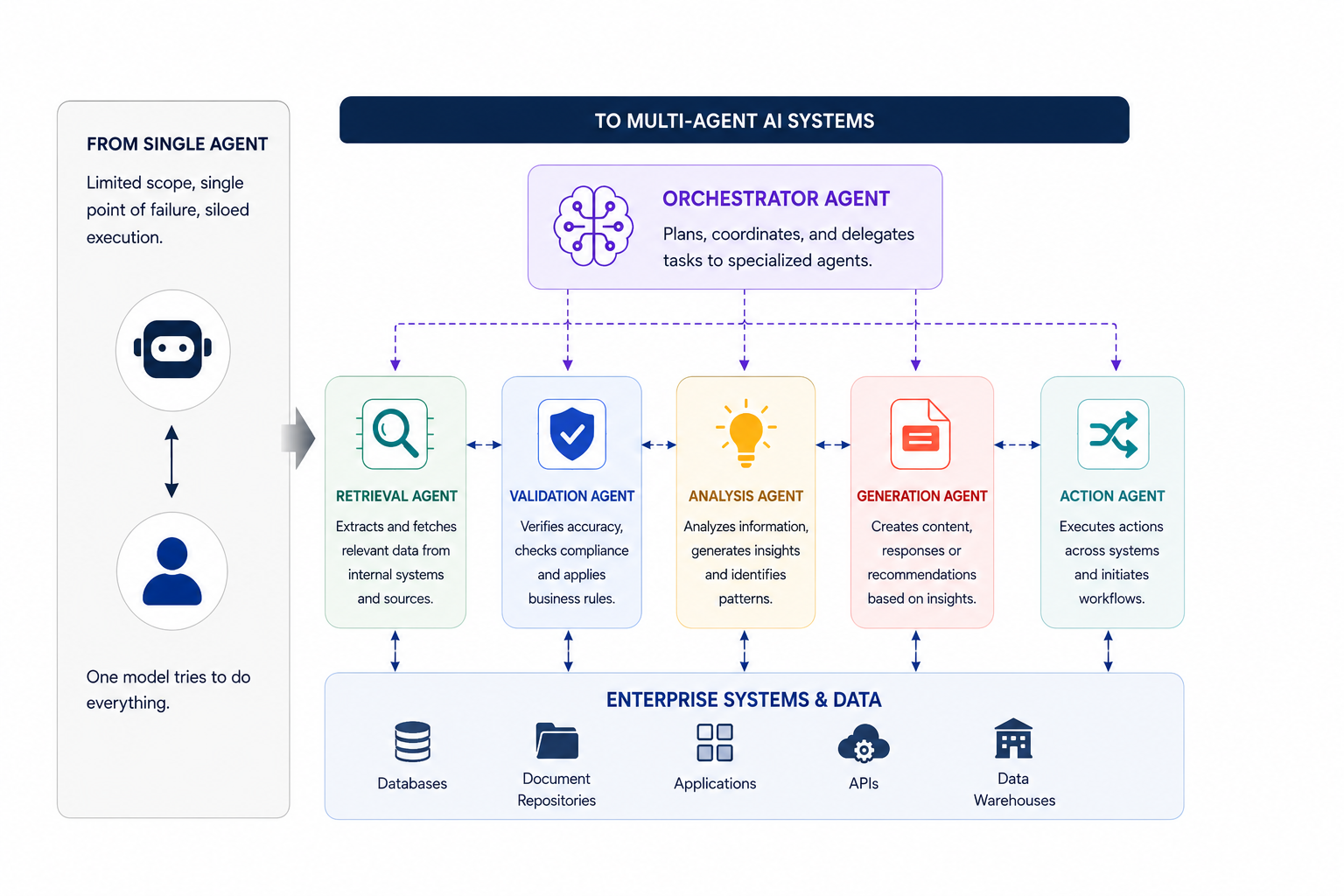
Early enterprise AI applications focused heavily on augmentation. AI copilots helped employees summarize documents, generate content, or answer questions faster. While valuable, these systems largely operated within narrow boundaries.Multi-agent systems change that architecture entirely.In a multi-agent environment, different AI agents are assigned specialized responsibilities. One agent may retrieve enterprise data, another may validate compliance requirements, another may generate insights, while a coordinating agent orchestrates the workflow and ensures task completion.Instead of one model attempting to do everything, enterprises distribute intelligence across multiple agents designed for distinct functions.

This mirrors how modern organizations themselves operate — through teams of specialists collaborating toward shared goals.

Why Enterprises Are Moving Toward Multi-Agent Architectures

The rise of multi-agent systems is not simply a technological trend. It is largely driven by the operational limitations enterprises encountered with single-agent AI deployments.

As workflows become more complex, enterprises require systems that can:

  • Handle multi-step reasoning
  • Access multiple enterprise systems
  • Coordinate across departments
  • Operate with human oversight
  • Adapt dynamically to changing conditions
  • Scale without central bottlenecks

Single-agent architectures struggle to maintain reliability and context across these environments. Multi-agent systems address this by breaking workflows into modular, manageable units. This modularity creates several enterprise advantages:

Improved Scalability

Specialized agents can scale independently depending on workload demand. Enterprises can optimize resources more effectively without overloading a single orchestration layer.

Better Reliability

Failures become isolated rather than systemic. If one agent encounters an issue, other agents can continue functioning while escalation or fallback mechanisms activate.

Domain Specialization

Agents can be trained or optimized for specific business functions such as fraud detection, supply chain analysis, compliance monitoring, or customer support.

Faster Workflow Execution

Parallel processing enables multiple agents to work simultaneously across tasks, significantly reducing operational latency.

The Enterprise Use Cases Driving Adoption

Multi-agent systems are already gaining traction across several enterprise functions.

Intelligent Customer Operations

Customer service workflows increasingly involve multiple specialized agents working together:

  • Intent classification agents
  • Knowledge retrieval agents
  • Sentiment analysis agents
  • Resolution recommendation agents
  • Escalation agents

Instead of a single chatbot attempting end-to-end support, enterprises are building coordinated ecosystems capable of delivering faster and more contextual customer experiences.

Financial Services and Risk Operations

Banks and insurance organizations are exploring multi-agent systems for areas such as:

  • Fraud detection
  • Claims processing
  • Policy validation
  • Compliance checks
  • Risk assessment

Research suggests that agent-based automation is particularly effective in environments requiring multi-step validation and auditability.

Software Development and IT Operations

AI agents are increasingly participating in software engineering workflows, including:

  • Code generation
  • QA testing
  • Vulnerability scanning
  • Deployment validation
  • Infrastructure monitoring

At Dell Technologies World 2026, enterprise leaders highlighted how agentic AI systems are already reducing development timelines and accelerating DevOps workflows.

Enterprise Knowledge and Decision Systems

Organizations are deploying multi-agent architectures to improve enterprise search, internal research, and decision intelligence.

In these systems:

  • Retrieval agents gather information
  • Validation agents verify credibility
  • Summarization agents synthesize insights
  • Governance agents enforce policy controls

This layered orchestration significantly improves reliability compared to traditional retrieval-only systems.

Why Governance and Orchestration Matter More Than Ever

As enterprises scale agentic AI, orchestration becomes the defining challenge.The problem is no longer whether AI can generate outputs. The challenge is whether enterprises can coordinate multiple AI systems safely, consistently, and transparently across real workflows.

This introduces new operational requirements:

Agent Orchestration Frameworks

Enterprises now require orchestration layers capable of:

  • Task delegation
  • State management
  • Inter-agent communication
  • Workflow prioritization
  • Human approval routing

Frameworks such as LangGraph, AutoGen, and CrewAI are increasingly being explored for enterprise-scale orchestration.

Governance and Observability

As agents gain autonomy, governance becomes critical.

Organizations must establish:

  • Real-time monitoring
  • Audit trails
  • Policy enforcement
  • Security guardrails
  • Human-in-the-loop validation

According to industry research, governance failures remain one of the biggest reasons AI agent pilots fail to scale into production.

Enterprises are realizing that trust cannot be added later. It must be embedded directly into agent architectures.

This includes:

  • Explainability layers
  • Permission controls
  • Reliability scoring
  • Failure recovery systems
  • Compliance enforcement

Without these controls, autonomous workflows quickly become operational risks rather than productivity multipliers.

The Shift From AI Tools to AI Workforces

Perhaps the most important shift is conceptual.Enterprises are beginning to move beyond thinking of AI as a standalone tool. Instead, AI is increasingly being treated as a coordinated digital workforce capable of participating in business operations.This does not mean fully autonomous organizations are imminent. Human oversight remains essential, particularly in regulated or high-risk environments. In fact, many enterprises continue validating AI decisions through human review layers before execution.

But the role of AI is clearly expanding:

  • From assistance to execution
  • From isolated prompts to orchestrated workflows
  • From single systems to collaborative agent ecosystems

That transition may ultimately define the next generation of enterprise software.

The Road Ahead

Multi-agent AI systems represent a major architectural shift in enterprise AI adoption.The organizations seeing the greatest value are not simply deploying smarter models. They are redesigning workflows around coordinated intelligence, orchestration, and operational integration.

The future of enterprise AI will likely depend less on individual model capability and more on how effectively enterprises can:

  • Coordinate specialized agents
  • Govern autonomous workflows
  • Integrate AI into core business operations
  • Maintain trust, accountability, and transparency at scale

The rise of multi-agent systems signals that enterprises are moving beyond experimentation and toward operational AI infrastructure.And in that future, the most successful enterprises may not be the ones with the largest models — but the ones with the best orchestration.

Blog

From Sampling to Surveillance: How AI is Redefining Continuous Auditing in Banking

Introduction

Auditing in banking was never built for speed.It was built for assurance.For decades, audit frameworks relied on sampling, periodic reviews, and retrospective validation. This approach worked in a world where transactions were slower, risks evolved gradually, and regulatory expectations followed defined cycles.But that world no longer exists.

Today, banking operates in real time. Transactions are instantaneous. Fraud is adaptive. Compliance expectations are continuous. Yet, auditing practices in many institutions still rely on examining a fraction of data—after the event.

This mismatch is no longer sustainable.

The Structural Gap in Traditional Auditing

At its core, traditional auditing is constrained by design.

Sampling-based methodologies assume that reviewing a subset of transactions is sufficient to infer the integrity of the whole. Periodic audits assume that risks can be assessed at defined intervals. Retrospective checks assume that identifying issues after occurrence is acceptable.

In today’s environment, these assumptions create critical gaps:

  • Delayed risk identification: Issues are often detected after impact
  • Limited coverage: Only a fraction of transactions are reviewed
  • Periodic assurance: Controls are validated at intervals, not continuously

As a result, audit functions often become a record of what went wrong—rather than a system that prevents it.

The Shift: From Sampling to Surveillance

Artificial Intelligence is fundamentally changing this paradigm.The shift is not about making audits faster. It is about making them continuous.

AI enables a move away from selective visibility to comprehensive monitoring:

  • From sampling → to 100% transaction monitoring
  • From periodic reviews → to continuous assurance
  • From retrospective checks → to real-time anomaly detection

Instead of asking “What happened?”, audit systems can now ask “What is happening—and what might happen next?”

This transition introduces a new model: continuous auditing, where every transaction, control, and exception is evaluated in real time.

Beyond Technology: The Operational Imperative

While AI provides the capability, technology alone does not deliver value.Continuous auditing creates impact only when it is operationalized effectively.

Real-time monitoring must be tightly integrated with decision-making and execution:

  • Immediate escalation mechanisms to flag critical anomalies
  • Automated control triggers to prevent or mitigate risk
  • Closed-loop resolution workflows to ensure faster remediation

Without these, organizations risk creating a system of real-time visibility without real-time action.

The true transformation lies not just in detecting risk—but in responding to it instantly.

Reimagining the Role of Audit

As auditing becomes continuous, its role within the organization evolves.Audit is no longer a periodic, independent checkpoint. It becomes an embedded, always-on capability—closely aligned with operations, risk, and compliance functions.

This shift redefines audit from:

  • A reporting function → to a preventive control layer
  • A retrospective evaluator → to a real-time risk intelligence engine
  • An isolated process → to an integrated part of operations

In this model, audit does not just validate controls—it actively strengthens them.

Challenges on the Path to Continuous Auditing

Despite its potential, the transition is not without challenges:

  • Data integration complexity across fragmented systems
  • Model explainability in highly regulated environments
  • Change management within audit and compliance teams
  • Balancing automation with governance and oversight

Addressing these requires a combination of robust data infrastructure, transparent AI models, and a clear operational framework.

The Road Ahead

The future of auditing in banking is not periodic—it is embedded.It is invisible in form, but critical in function.It operates continuously, adapts dynamically, and connects directly to decision-making.As banks continue to digitize and scale, the question is no longer whether to adopt continuous auditing—but how quickly they can transition.

Because in a real-time world, assurance cannot remain retrospective.

Conclusion

The move from sampling to surveillance marks a fundamental shift in how banks approach risk and control.AI is not just enhancing auditing—it is redefining its purpose.

From static reviews to continuous monitoring.
From delayed insights to real-time intelligence.
From audit reports to audit-driven action.

Organizations that embrace this shift will not only improve compliance—they will build stronger, more resilient systems designed for the realities of modern banking.

Blog

From SaaS to AaaS: When Software Starts Delivering Outcomes, Not Just Capabilities

For over two decades, the enterprise technology landscape has been defined by Software-as-a-Service (SaaS). It transformed how organizations access and deploy software—making it scalable, flexible, and continuously evolving. From CRM systems to marketing platforms to analytics tools, SaaS enabled businesses to digitize operations at an unprecedented pace.However, despite this widespread adoption, a fundamental gap has persisted.Enterprises today are not constrained by a lack of tools or insights. In fact, most organizations have more dashboards, models, and systems than ever before. The real challenge lies elsewhere—in translating those capabilities into consistent, timely action.

Insights are generated, recommendations are surfaced, and workflows are designed. Yet execution continues to depend heavily on human intervention—introducing delays, inconsistencies, and missed opportunities. This “last mile” between decision and action remains one of the most persistent bottlenecks in enterprise operations.

It is within this context that a new paradigm is beginning to emerge: Agents-as-a-Service (AaaS).

The Limits of the SaaS Model

SaaS fundamentally operates as a capability layer. It provides the tools and environments within which users can perform tasks, make decisions, and manage workflows. While this model has been highly effective in enabling access and scale, it stops short of owning outcomes.A predictive model embedded within a SaaS platform can identify customers at risk of churn. A marketing automation tool can enable campaign execution. A dashboard can highlight performance gaps in near real time. Yet in each of these scenarios, the responsibility for interpreting the signal, deciding on the next step, and initiating action still lies with a human operator.

This reliance creates friction. Decisions are delayed, execution varies across teams, and the impact of even the most sophisticated models is diluted. In many organizations, the gap is not in intelligence—it is in operationalizing that intelligence at scale.

Agents as the Execution Layer

Agents-as-a-Service introduces a structural shift by adding an execution layer on top of existing systems.Unlike traditional software, AI agents are not limited to providing information or enabling workflows. They are designed to take action—to plan, execute, and iterate within defined objectives and constraints. By integrating data, models, and business rules, agents can operate across workflows with a degree of autonomy that was previously not possible.This fundamentally changes how work flows through an organization.Instead of a linear process where data informs insights and humans drive execution, agents compress this cycle. Decisions can now move directly from signal to action, with systems continuously learning and adapting based on outcomes.

The shift is not merely about automation in the traditional sense. It is about creating systems that are responsible for delivering results, not just enabling processes.

From Access-Based to Outcome-Based Models

One of the most significant implications of this shift is the change in how technology is valued and consumed.SaaS is inherently access-driven. Organizations pay for the ability to use software—whether that software ultimately drives business outcomes depends on how effectively it is utilized.AaaS, by contrast, aligns more closely with outcomes. As agents take on execution responsibilities, the value delivered is increasingly tied to what gets done rather than what is available.This redefines the relationship between enterprises and technology. Instead of investing in tools with the expectation of downstream impact, organizations can begin to evaluate systems based on their ability to directly influence metrics such as revenue growth, cost efficiency, or customer retention.

Over time, this shift has the potential to reshape pricing models, performance expectations, and even how success is measured across technology investments.

Implications for Enterprise Operating Models

The transition from SaaS to AaaS is not just a technological evolution—it has meaningful implications for how organizations operate.First, it changes the role of human decision-makers. As agents assume responsibility for routine and repeatable execution, human involvement shifts toward defining strategy, setting constraints, and overseeing performance. The emphasis moves from doing to directing.Second, it introduces the need for robust orchestration layers. Agents must operate within a coordinated system that aligns actions across functions, ensures consistency, and integrates with existing infrastructure. This requires platforms that can bridge data, decisioning, and execution seamlessly.Third, it elevates the importance of governance and trust. Autonomous systems must be transparent, controllable, and aligned with business objectives. Without clear guardrails and visibility, organizations will struggle to scale agent-driven execution.

Finally, it begins to address one of the most persistent challenges in enterprise technology—the fragmentation of tools. By focusing on execution rather than isolated capabilities, AaaS encourages a more integrated approach where systems work together to deliver continuous outcomes.

The Road Ahead

It is important to recognize that AaaS will not replace SaaS in the near term. Instead, it will build on top of it.Existing SaaS platforms will continue to provide the foundational layers of data, infrastructure, and domain-specific functionality. However, the layer that increasingly drives value will be the one that connects these capabilities to real-world execution.As organizations continue to invest in AI and advanced analytics, the focus will gradually shift from generating better insights to ensuring those insights are acted upon consistently and at scale.

In that sense, the rise of AaaS represents a natural progression—one that brings enterprises closer to closing the long-standing gap between knowing and doing.

Conclusion

SaaS transformed how organizations access and deploy technology, enabling a generation of digital-first enterprises. Yet, access alone has never been sufficient to drive outcomes.Agents-as-a-Service signals the next phase of this evolution—where systems move beyond supporting decisions to actively carrying them through.As this shift unfolds, the defining question for enterprises will no longer be about the tools they use, but about the outcomes they can reliably achieve through them.

In a landscape where speed, consistency, and scale are critical, the ability to translate intelligence into action may ultimately become the most important capability of all.